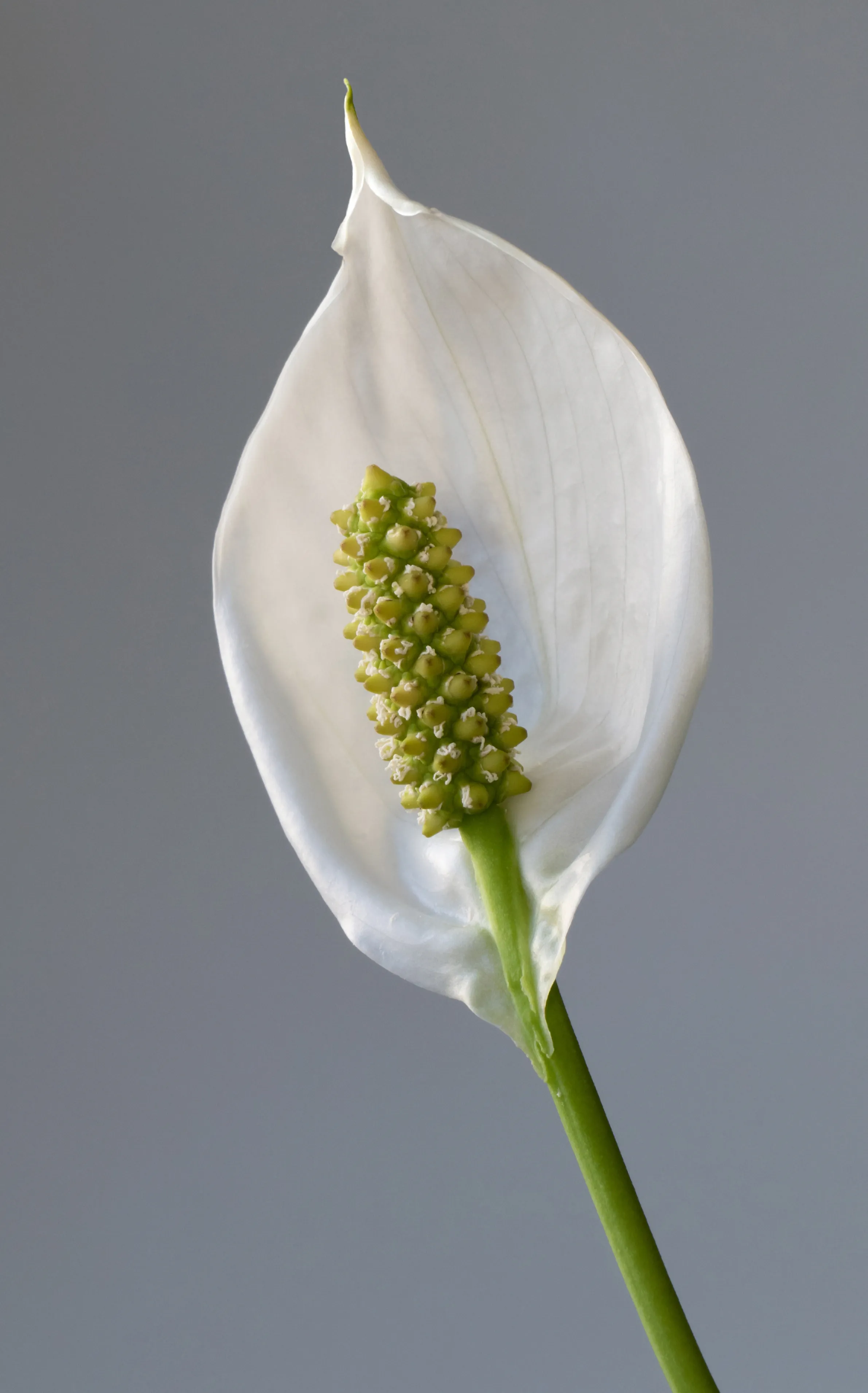
Peace Lily
Spathiphyllum wallisii
Complete care guide and energetic profile for Spathiphyllum — the graceful, air-purifying peace lily.
Low to medium indirect
Keep lightly moist, water when top inch dries
Above 50%
16-27°C
The Peace Lily is one of the few flowering houseplants that genuinely thrives in low light, making it a practical choice for dim hallways, north-facing rooms, and office spaces. Native to the tropical forests of Central and South America, Spathiphyllum produces elegant white spathes above glossy dark green foliage. It is also one of the most well-documented air-purifying plants — though the science behind how it works is more interesting than the headline suggests.
Light Requirements
Peace lilies are remarkably shade-tolerant and will grow happily in low to medium indirect light. They can survive in rooms lit only by fluorescent lighting. For the best chance of flowering, provide bright indirect light — an east-facing windowsill or a spot a metre or two back from a south-facing window. Avoid direct sunlight, which scorches the leaves. If your peace lily produces lush foliage but refuses to bloom, insufficient light is almost always the reason.
Watering
Peace lilies are dramatic communicators. When the plant is thirsty and water loss through its leaves begins to outpace what the roots can supply from dry soil, the cells lose turgor pressure — the internal water pressure that keeps plant tissue firm and upright. The leaves go limp and droop dramatically. Once watered, the plant rapidly absorbs moisture, the cells expand back to their original size, and the turgor pressure is restored. The plant stands upright again within hours.
This mechanism is a useful indicator, but repeatedly letting the plant wilt stresses the root system over time and shortens its lifespan. Treat it as an alert, not as a regular care schedule. Water when the top inch of compost feels dry — typically once or twice a week in summer, weekly in winter. Use room-temperature water and avoid leaving the pot in standing water.
Humidity and Temperature
Spathiphyllum evolved in tropical understory conditions with consistently high moisture in the air. Brown leaf tips are the signal that your indoor air is too dry — the VPD pulling moisture from the leaf tissue faster than the roots can replace it. A pebble tray, humidifier, or naturally humid location such as a well-lit bathroom all help. Temperature should stay between 16 and 27 degrees Celsius. Below 12 degrees can cause lasting damage — cold draughts from windows or exterior doors should be kept away from the plant.
Air Purification
The NASA Clean Air Study showed that peace lilies can remove VOCs (volatile organic compounds) — including benzene and formaldehyde — from indoor air. What the research actually reveals is that the primary mechanism is microbial: the microorganisms living in the plant’s potting medium are the main agents breaking down these airborne chemicals. The plant’s role is largely to sustain that root microflora. This means healthy soil matters as much as the plant itself. Flush the pot occasionally to prevent salt buildup, repot with fresh compost every year or two, and the biological system that cleans the air remains effective.
Feeding and Soil
Feed every four to six weeks during the growing season at half strength. Over-fertilising is a common mistake — it causes brown leaf tips and salt accumulation in the soil. If you notice a white crust on the soil surface, flush the pot thoroughly with plain water to leach out excess salts. Use a well-draining, peat-free houseplant compost: two parts compost to one part perlite provides the moisture retention these plants enjoy while maintaining adequate drainage. Repot every one to two years in spring.
Common Issues
- Brown leaf tips — Low humidity or over-fertilisation. Increase humidity and reduce feeding.
- Yellow leaves — Overwatering. Let the soil dry slightly more between waterings.
- No flowers — Insufficient light. Move to a brighter indirect spot.
- Drooping leaves — Thirst (turgor pressure loss). Water and the plant should recover within hours.
- Black leaf edges — Cold damage or root rot from waterlogged soil.
- Mealybugs — Check where leaves meet stems. Treat with neem oil or rubbing alcohol.
The peace lily gives a great deal back with minimal demands — clean air, quiet elegance, and a plant that tells you clearly when it needs something.
Growing More Peace Lily
Peace Lily can be propagated by division. Step-by-step guides with the biology explained:
Troubleshooting Peace Lily
If your Peace Lily is showing yellow leaves, brown tips, drooping, root rot, leggy growth, or signs of pests — the troubleshooting hub has biology-first diagnosis guides for every common problem.
Go to troubleshooting hubDiscover the spiritual side of Peace Lily
Peace Lily resonates with Water energy, the Crown (Sahasrara) chakra, and is ruled by Moon. Explore the full energetic profile, ideal placement, and spiritual properties in the Mist collection.
View Energy Profile