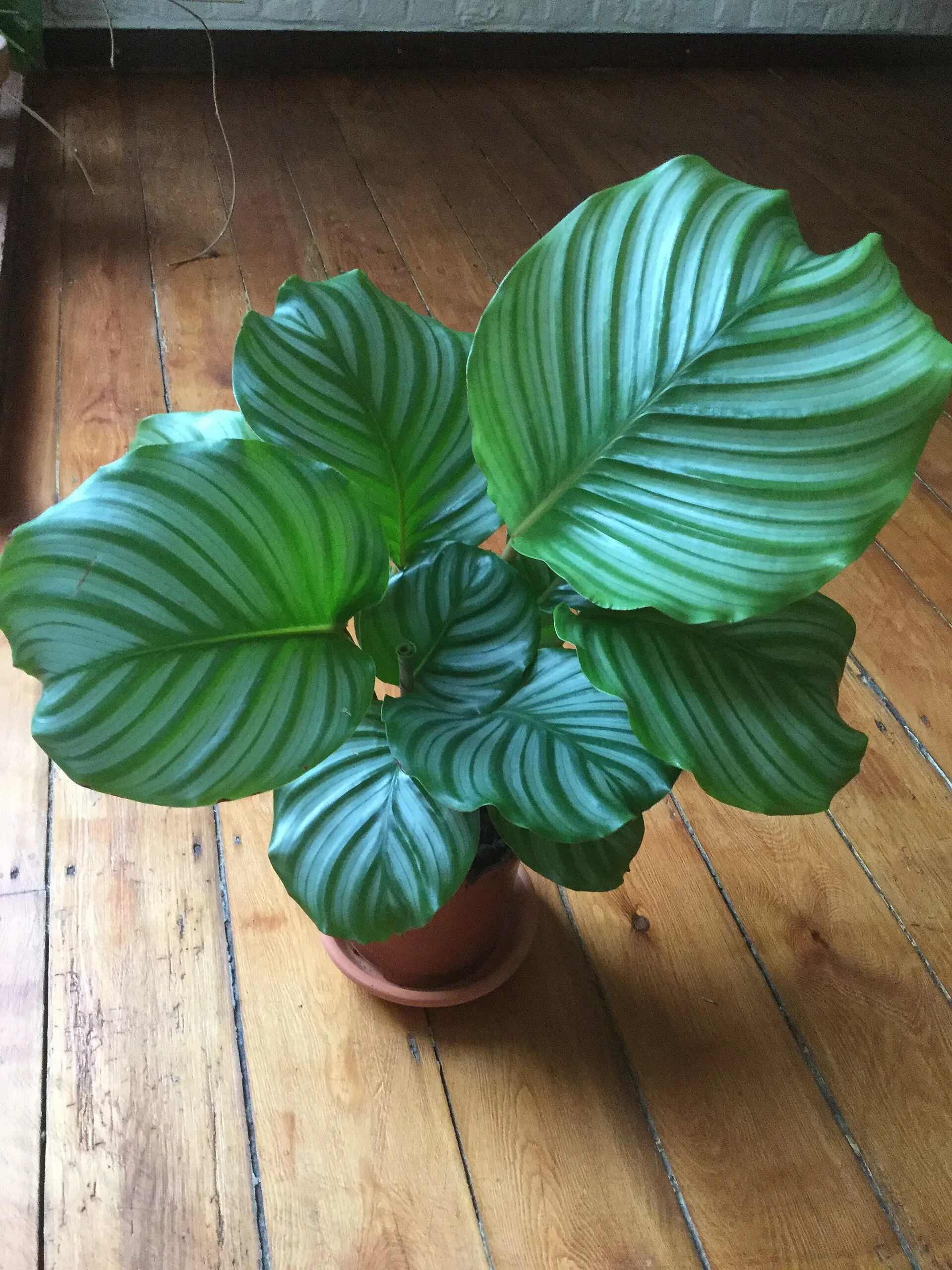
Calathea
Calathea orbifolia
Complete care guide and energetic profile for Calathea orbifolia — the stunning prayer plant with silvery striped leaves.
Medium indirect
Keep consistently moist, never soggy
Above 60%
18-27°C
Calathea orbifolia is widely regarded as one of the most beautiful foliage plants in the world, and for good reason. Its large, round leaves are painted with alternating stripes of silver-green and deep emerald, creating an effect that looks almost hand-painted. Native to the tropical forests of Bolivia, this member of the Marantaceae (prayer plant) family folds its leaves upward at night in a gentle movement called nyctinasty, then opens them again at dawn. It is non-toxic and safe around pets and children, but its care requirements demand attention and consistency.
Light Requirements
Calathea orbifolia evolved on the tropical forest floor — a world of dappled shade, consistent warmth, and high moisture. Medium indirect light, like that from a north- or east-facing window, mirrors that environment closely. Direct sun bleaches the beautiful leaf markings and causes the edges to curl and crisp. Too little light slows growth and causes the vivid leaf contrasts to fade.
Calatheas are sensitive to sudden changes in environment, so always transition them slowly when moving them to a new position.
Watering
The most consistent challenge with Calathea orbifolia is water quality, not quantity. Fluoride, chlorine, and dissolved minerals in tap water are actively harmful to this plant. The vascular system carries these chemicals outward to the leaf edges and tips — the furthest tissue from the roots — where they accumulate to toxic concentrations and cause cell death. The result is the characteristic brown, crispy leaf margins that no amount of humidity adjustment will fix once they appear.
Use filtered water, rainwater, or leave tap water to stand uncovered for twenty-four hours before using (this allows chlorine to off-gas, though it does not remove fluoride). Always water at room temperature.
Beyond water quality, keep the soil consistently moist but never waterlogged. Water when the top half-inch feels dry — usually every four to seven days.
Humidity and Temperature
Calathea orbifolia has large, broad leaves with a significant surface area exposed to the air. In low humidity, the Vapor Pressure Deficit between the moisture-saturated tissue inside the leaf and the drier surrounding air drives rapid water loss through the stomata. The plant loses water through its leaves faster than its roots can supply it — and the first casualties are the leaf margins, where tissue begins to die.
Below fifty per cent humidity the symptoms are clear: edges brown and curl regardless of how carefully you water. Above sixty per cent, the plant is genuinely comfortable. A humidifier running nearby is the most reliable solution. A well-lit bathroom or grouping with other moisture-loving plants also helps.
Temperature should stay between 18 and 27 degrees Celsius with minimal fluctuation. Calatheas respond to temperature swings — cold draughts, air conditioning vents, or radiators — by tightly curling their leaves as a stress response.
Nyctinasty
One of Calathea’s most fascinating traits is the daily movement of its leaves — folding upward at night and opening again at dawn. This is driven by a specialised joint-like organ at the base of each leaf called the pulvinus. Motor cells within it pump potassium ions and water in or out in response to changing light levels and circadian rhythms; the resulting changes in cell turgor pressure physically move the leaf. If your Calathea stops making these movements, it is typically a sign of stress — often inconsistent watering, temperature extremes, or root issues.
Feeding and Soil
Feed monthly during the growing season at half or quarter strength — calatheas burn easily from excess fertiliser salts. Stop in autumn and winter. The ideal mix is light and moisture-retentive but airy: two parts peat-free compost, one part perlite, one part coco coir. Avoid heavy compacted soil. Repot in spring every one to two years; handle roots gently, as calatheas are slow to recover from root disturbance.
Common Issues
- Crispy brown leaf edges — Water quality or low humidity. Switch to filtered water and increase humidity.
- Curling leaves — Too cold, too dry, or direct light. Check all three.
- Yellowing leaves — Overwatering or poor drainage. Let the soil dry slightly more between waterings.
- Fading leaf patterns — Light level needs adjusting, gradually.
- Spider mites — Thrive in dry conditions. Boosting humidity helps prevent them. Treat with neem oil or insecticidal soap on leaf undersides.
- Leaves not closing at night — A stress signal. Check watering consistency and temperature stability.
Calathea orbifolia is demanding because it is specific — it needs close conditions to what it evolved in. Once those conditions are consistent, it settles and grows beautifully. The daily leaf movements alone make it unlike almost any other plant you can keep indoors.
Growing More Calathea
Calathea can be propagated by division. Step-by-step guides with the biology explained:
Troubleshooting Calathea
If your Calathea is showing yellow leaves, brown tips, drooping, root rot, leggy growth, or signs of pests — the troubleshooting hub has biology-first diagnosis guides for every common problem.
Go to troubleshooting hubDiscover the spiritual side of Calathea
Calathea resonates with Water energy, the Third Eye (Ajna) chakra, and is ruled by Neptune. Explore the full energetic profile, ideal placement, and spiritual properties in the Mist collection.
View Energy Profile