String of Pearls
Senecio rowleyanus
Complete care guide and energetic profile for Senecio rowleyanus — the cascading succulent with bead-like foliage.
Bright indirect to some direct morning sun
Every 2 weeks, let soil dry completely
Low to average (30-50%)
15-27°C
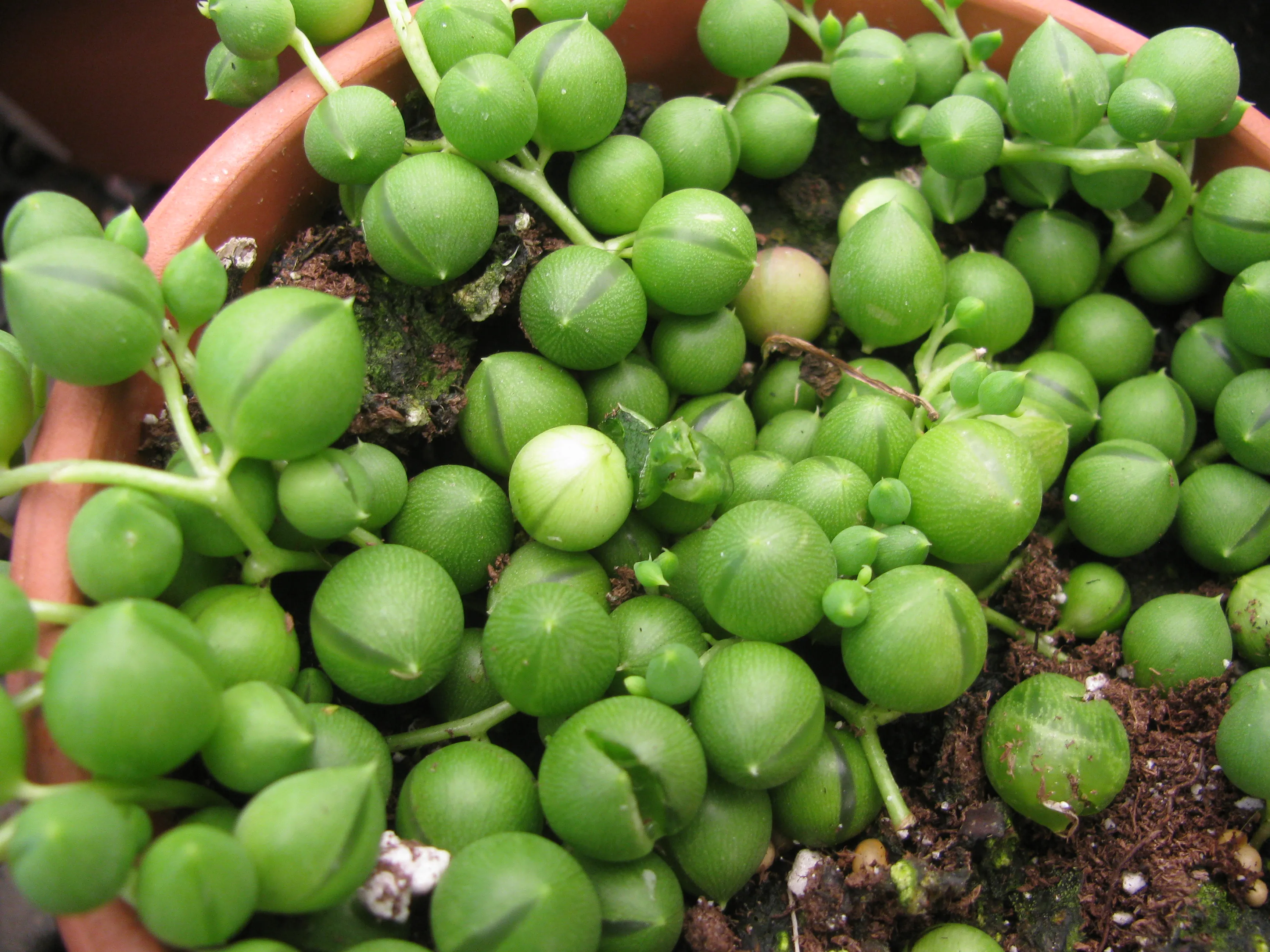
String of Pearls is one of the most distinctive trailing succulents you can grow indoors. Each stem is adorned with small, spherical leaves that resemble a strand of green beads, cascading beautifully over the edge of a hanging planter or high shelf. Senecio rowleyanus is native to the dry regions of southwest Africa, where it creeps along the ground under the partial shade of taller plants and rock formations.
The Biology of the Bead
Those pearl-shaped leaves are a remarkable piece of evolutionary geometry. A sphere holds the maximum volume of water for the absolute minimum surface area exposed to the environment — meaning each bead stores as much moisture as possible while minimising the surface through which it can evaporate in the hot, dry African air. It is the most efficient water-storage shape in nature, and Senecio rowleyanus arrived at it independently.
The surface of each pearl also contains a small translucent strip — a “leaf window” — that allows light to reach the interior cells for photosynthesis without the entire surface needing to be exposed to the sun.
Light Requirements
String of Pearls needs bright indirect light with some direct morning sun for best results. An east-facing window is the ideal location. In a south- or west-facing window, place the plant a foot or two back or use a sheer curtain. Too much direct afternoon sun burns the pearls, turning them brown and shrivelled. Too little light causes the stems to stretch with wide gaps between beads — producing a sparse, leggy appearance rather than dense, full strands.
Watering
Allow the soil to dry out completely between waterings — typically every ten to fourteen days in summer and every three to four weeks in winter. The most reliable method is bottom-watering: set the pot in a tray of water for fifteen to twenty minutes, then remove and let it drain. This keeps water away from the dense tangle of stems and beads at the soil surface, where moisture sitting against the tissue encourages rot.
If the pearls start to look slightly deflated or wrinkled, the plant is ready for water. Mushy, translucent beads mean you’ve watered too often or too recently.
Humidity and Temperature
String of Pearls prefers average to low humidity between thirty and fifty per cent — the dry air of most heated homes suits it well. High humidity combined with poor air circulation increases the risk of fungal stem rot. Keep between 15 and 27 degrees Celsius. A slightly cooler rest period around 12 to 15 degrees in winter can trigger spring flowering — small, white, cinnamon-scented blooms that most owners don’t expect from this plant.
Feeding and Soil
Feed once a month in spring and summer with a cactus and succulent fertiliser at half strength. No feeding in autumn or winter. The potting mix must be extremely fast-draining: equal parts peat-free compost, perlite, and coarse sand or fine grit, or a cactus mix with extra perlite. Terracotta pots wick moisture away from the soil and are strongly recommended. The root system is shallow and modest — repotting is rarely needed.
Common Issues
- Mushy, translucent beads — Overwatering. Remove affected stems, let soil dry completely, reduce watering.
- Flat, deflated pearls — Thirst. Bottom-water thoroughly.
- Leggy stems with gaps between pearls — Insufficient light. Move to a brighter position.
- Stem rot at the soil line — Excess moisture around the crown. Improve drainage.
- Mealybugs — Can hide among the dense beads. Treat with rubbing alcohol on a cotton swab.
- Browning pearls near the soil — Buried strands staying too wet. Trim dead sections and improve airflow.
String of Pearls is one of those plants that rewards understanding its origins. Treat it like a desert plant — bright light, infrequent water, fast soil — and it will reward you with those cascading strands that make it one of the most admired plants you can display.
Growing More String of Pearls
String of Pearls can be propagated by stem cuttings. Step-by-step guides with the biology explained:
Troubleshooting String of Pearls
If your String of Pearls is showing yellow leaves, brown tips, drooping, root rot, leggy growth, or signs of pests — the troubleshooting hub has biology-first diagnosis guides for every common problem.
Go to troubleshooting hubDiscover the spiritual side of String of Pearls
String of Pearls resonates with Air energy, the Throat (Vishuddha) chakra, and is ruled by Mercury. Explore the full energetic profile, ideal placement, and spiritual properties in the Mist collection.
View Energy Profile