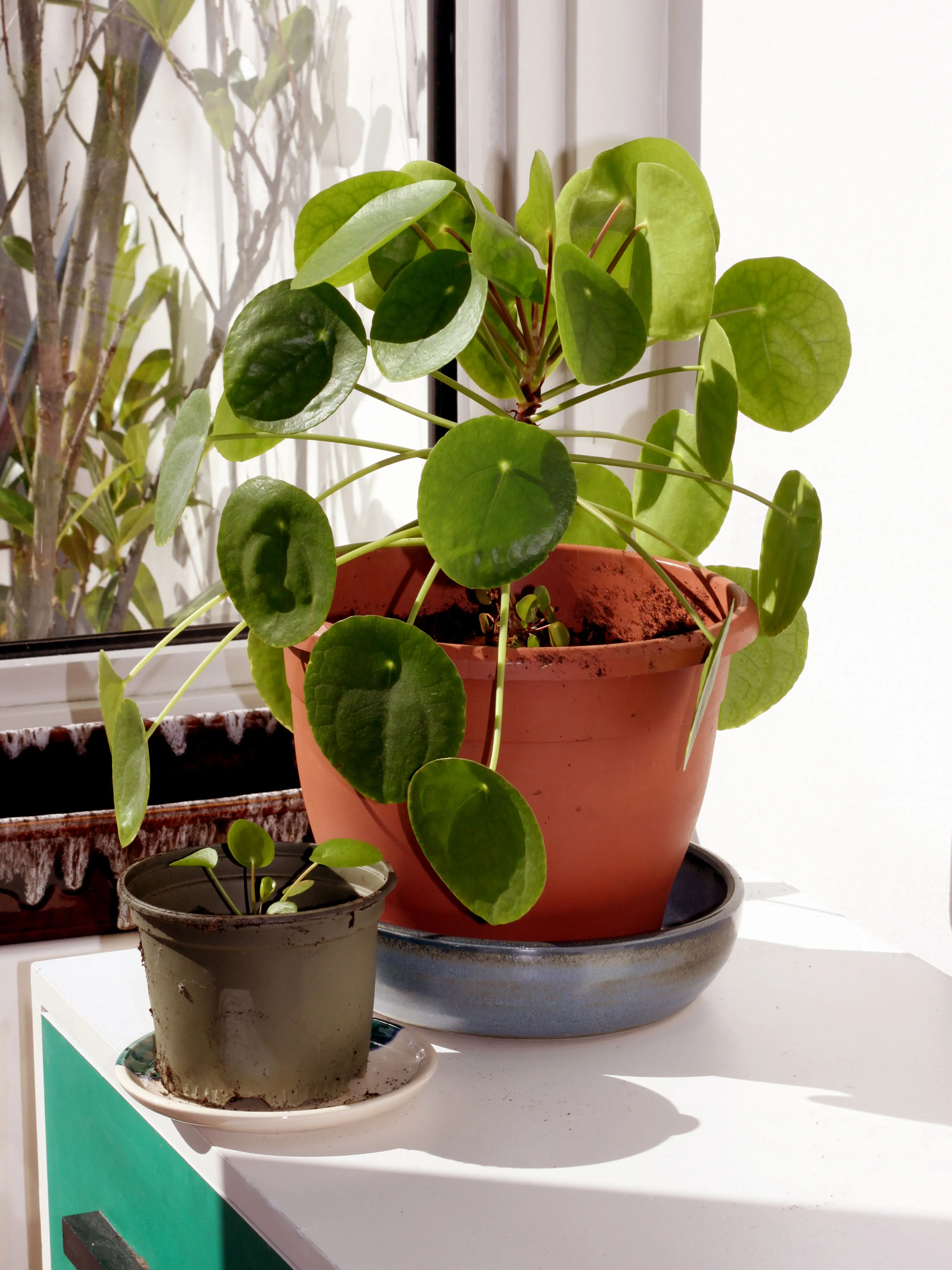
Chinese Money Plant
Pilea peperomioides
Complete care guide and energetic profile for Pilea peperomioides — the charming, coin-leaved Chinese money plant.
Bright indirect
Weekly, let top inch dry
40-60%
15-27°C
The Chinese Money Plant, also known as the Friendship Plant or Pancake Plant, has become one of the most sought-after houseplants in recent years, prized for its distinctive round, coin-shaped leaves perched on slender petioles. Pilea peperomioides was originally collected by a Norwegian missionary in Yunnan province, China, in 1946 and spread throughout Scandinavia through cuttings shared between friends — hence its common names. It produces an abundance of offsets, making it one of the easiest plants to propagate and share, which has only added to its popularity and symbolism of generosity.
Light Requirements
Pilea peperomioides needs bright indirect light — an east- or west-facing window is ideal. In too little light, the plant demonstrates phototropism: its stems bend decisively toward the nearest light source as a result of auxin hormones accumulating on the shaded side of the stem. These auxins cause cells on the dark side to elongate more than those in the light, physically bending the stem toward the window. New leaves also come in smaller, and the overall form becomes stretched and lopsided.
Rotating the pot a quarter turn every week counteracts this, producing the even, symmetrical shape the plant is admired for. It also encourages a thicker, more compact habit. Direct afternoon sun can scorch the thin leaves.
Watering
Water when the top inch of soil feels dry — roughly once a week in spring and summer, every ten to fourteen days in winter. Pilea prefers a thorough soak followed by complete drainage rather than frequent shallow waterings. Its roots are relatively delicate and do not tolerate waterlogged soil. Drooping or curling leaves are typically the first sign of thirst; the plant perks up within hours of watering. Overwatering shows as yellowing lower leaves or a soft, darkened stem base. Always empty the saucer after watering.
Humidity and Temperature
One of Pilea’s genuinely easy-going qualities is its tolerance of standard household humidity between forty and sixty per cent. In very dry winter air the leaf edges may develop slight browning, but it handles most conditions without complaint. Avoid getting water on the leaves — mineral deposits from tap water leave white spots on the coin-shaped surface.
Temperature should stay between 15 and 27 degrees Celsius. A slight drop to around 13 degrees in winter can encourage offset production — the plant interprets the temperature change as a seasonal cue and responds by sending up new shoots from its base.
Feeding and Soil
Feed once a month during the growing season at half strength. Stop from late autumn through winter. Over-fertilising leads to salt buildup and leggy, soft growth. A well-draining mix — two parts peat-free compost to one part perlite — suits the compact, shallow root system well. A pot that is too large stays wet for too long; keep the container modestly sized. Repot every one to two years in spring.
Offsets
Pilea peperomioides reproduces asexually, sending up new plantlets from its base once the mother plant is established. These offsets develop their own root systems while still attached, and can be detached and potted individually once they have three to four leaves. This is the tradition that gave the plant its name — a species that spreads plant to plant, friend to friend.
Common Issues
- Leaves curling inward — Underwatering or too much direct light.
- Yellow lower leaves — Overwatering. Allow the soil to dry out more between waterings.
- Leggy, stretched stems — Insufficient light. Move to a brighter spot and rotate regularly.
- White mineral spots on leaves — Dissolved salts from tap water. Wipe with a damp cloth and switch to filtered water.
- Drooping leaves — Almost always thirst. Water and the leaves should perk up within a few hours.
Few houseplants combine charm, ease of care, and prolific propagation quite like the Chinese Money Plant. Once you have one, you will always have more to share.
Growing More Chinese Money Plant
Chinese Money Plant can be propagated by offsets & pups. Step-by-step guides with the biology explained:
Troubleshooting Chinese Money Plant
If your Chinese Money Plant is showing yellow leaves, brown tips, drooping, root rot, leggy growth, or signs of pests — the troubleshooting hub has biology-first diagnosis guides for every common problem.
Go to troubleshooting hubDiscover the spiritual side of Chinese Money Plant
Chinese Money Plant resonates with Earth energy, the Solar Plexus (Manipura) chakra, and is ruled by Jupiter. Explore the full energetic profile, ideal placement, and spiritual properties in the Mist collection.
View Energy Profile